
Daily Stack 20260125 – Polar Vortex Revisited
Global warming is causing frigid winters for the mid-latitudes with extreme health and safety risks.


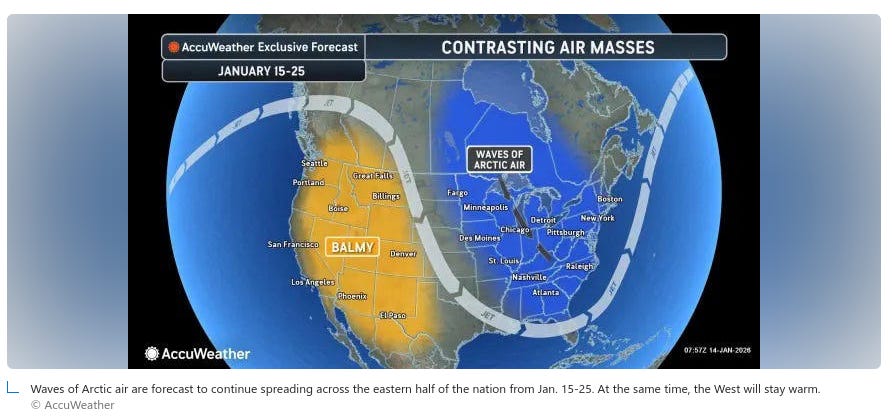
Jet stream reaching far south with polar Arctic air (https://www.msn.com/en-us/weather/topstories/january-polar-vortex-forecast-warns-of-2-arctic-blasts/ar-AA1Uru7P)
Another Winter with Another Polar Vortex
Almost a year ago we published a post on a polar vortex gripping North America causing severe cold and hazardous winter weather including storms (https://bitsbytesclimatescience.substack.com/p/daily-stack-20250219 ). The jet stream normally keeps the cold Arctic air confined to the north but as climate change has weakened the jet stream causing it to meander and stall, that cold Arctic air has slipped south and deep into the mid-latitudes as shown in the image above.
Again we see the cold air meeting and mixing with moist air from the south creating storms that result in strong winds, snow fall and freezing rain. These are hazardous conditions that are a threat to our safety and property.
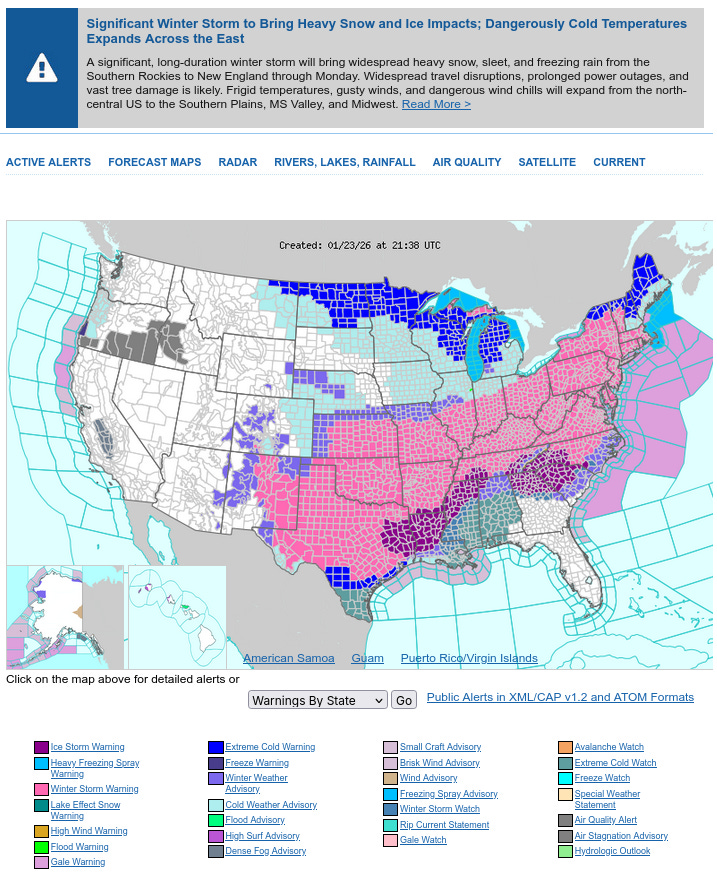
Winter storm conditions for Friday January 23, 2026, National Weather Service (https://www.weather.gov/)
The Role of Climate Change
A strong jet stream is caused by a strong difference in temperature between latitudes. Because of global warming, the Arctic is warming much faster relative to the rest of the world. This causes the temperature difference between the Arctic and the mid-latitudes to weaken which in turn causes the polar jet stream to weaken and become more wavy, meander and stall, and at times break. This results in the colder Arctic air to funnel south into regions where such cold temperatures are not expected. This causes significant weather changes including severe winter storms. We do not see this phenomenon in the Antarctic as the rate of warming is not yet as significant due to the sheer ice volume of Antarctica.
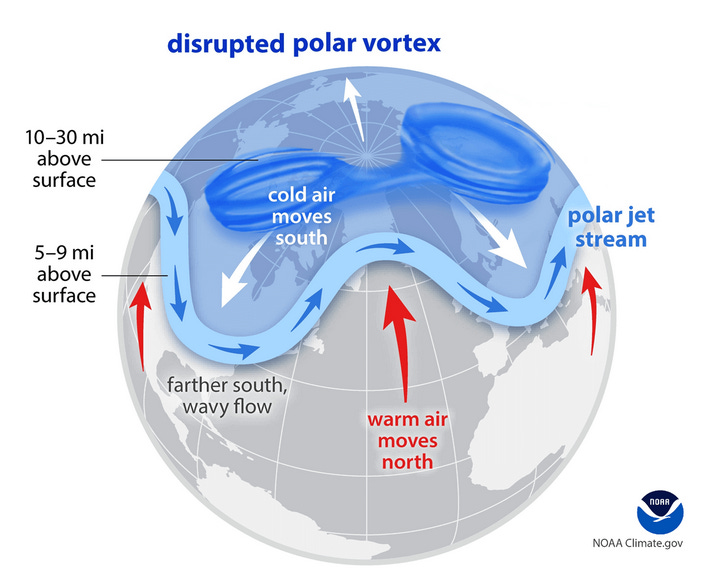
Illustration of weakened polar jet stream (https://www.severe-weather.eu/global-weather/polar-vortex-split-after-stratospheric-warming-january-winter-weather-united-states-canada-europe-fa/ )
While cold Arctic air slips south, we also see warmer air flowing north to replace it (see above figure). This warm air further allows the Arctic to warm. There is a feed-back mechanism which accelerates the impact of global warming causing further climate change.
What’s Stratospheric Warming
We hear in the media about stratospheric warming that is causing this polar air to slip south. So what is its role and how does it influence the jet stream and the polar vortex?
We all live in the troposphere. The stratosphere is the layer of atmosphere above it. These two layers are obviously linked and when the troposphere warms and the polar jet stream weakens, this slow down in the jet stream causes a slow down in the stratosphere’s polar jet stream above it.
Furthermore the warmer (due to global warming) troposphere rises and compresses the stratosphere above causing it to warm and further disrupting its flow (vortex). This compression and weakened flow can cause the stratospheric vortex to break apart into two smaller vortices.
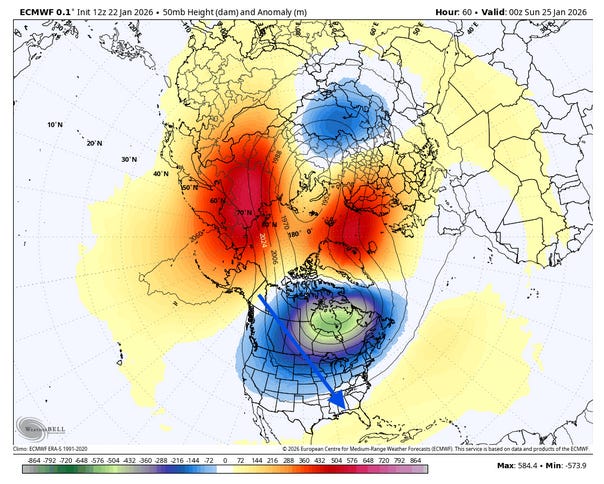
Stratospheric vortex split into two (concentric contours, with one over N. America) and associated cold temperatures (blue) with warming areas (red), Jan 22, 2026 (https://www.severe-weather.eu/global-weather/polar-vortex-collapse-stratospheric-warming-february-2026-cold-united-states-canada-europe-fa/)
Scientists have observed that climate change has been causing these sudden stratospheric warming to increase in duration and strength (daily spatial extent) since the 1980s. They found that these events have increased by about 5 more days in duration and about 40% in strength since then (https://acp.copernicus.org/articles/23/1259/2023/acp-23-1259-2023.pdf).
Using climate models, other scientists have shown that as our climate changes, we can expect an increase in the frequency of these stratospheric warming events between the earlier and latter half of this century by as much as 15% (https://scholarworks.sjsu.edu/cgi/viewcontent.cgi?article=8344&context=etd_theses).
We can expect more frequent and severe winter weather far south into North America in the coming years.
Look Up, Look Down, Look Around
Here we summarize what we wrote last year and include an aid in visualizing the knock-on effects of climate change and its impacts.
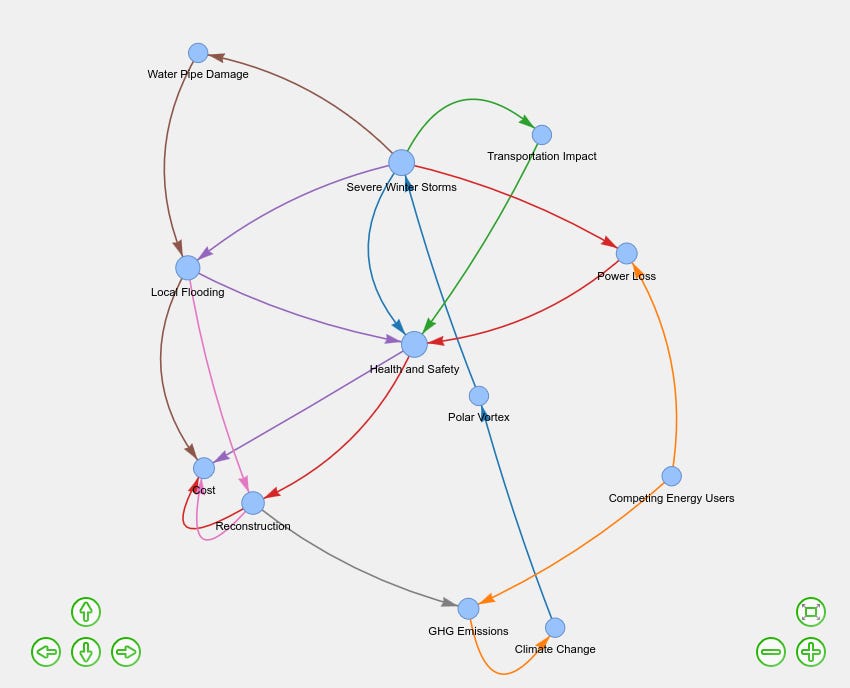
Simplified consequences of a Polar Vortex. Each path has a different colour for clarity (Bits and Bytes)
Look Up: From the regular weather forecasts, we often have fair warning (1 - 2 weeks) of oncoming cold weather caused by the polar vortex and associated winter storms. Share in the comments your favourite weather news sources.
Look Down and Around: Keep watch on the temperature from the weather forecast or using an outdoor thermometer.
If the temperature is near 0 C (32 F) and precipitation occurs, this can be freezing rain which can create hazardous walking and driving conditions, ice build up on tree limbs and power lines can down those power lines.
Below freezing temperatures can produce significant snow requiring removal. Heavy snow loads can also cave in roofs. Freezing temperatures can also cause water pipes to freeze and rupture causing home flooding. This can also happen to water mains causing neighbourhood flooding. If snow happens in areas where it usually does not, then this can cause hazardous driving and transportation conditions.
Above freezing, we can expect significant rainfall resulting in flooding. Power outages usually follow these severe weather events and secure power becomes acute during these times. Disruption in power also leads to impact on health and safety in addition to the weather conditions themselves.
Competing for secure power are other sectors and industries. This includes hospitals and emergency response, municipal services, telecoms and data centres, and all other sectors we depend on for a functioning society.
Any disruption and damage to our homes, infrastructure, response to emergencies caused by the winter storms all require clean up and reconstruction. These activities result in an increase in greenhouse gas (GHG) emissions that further contribute to climate change. With increases in cold spells we need to think about the insulation in our houses, whether windows need to be double glazed, and if we need extra heaters. And we need to understand the energy cost consequences and GHG emissions of these decisions including redundancy and backup generators.
All of these negative consequences increase costs including insurance rates.
Thanks for reading Bits & Bytes of Climate Science! If you enjoyed this post, please click ♡ below, and help bits & bytes of climate science reach a wider audience.